Showing posts with label review. Show all posts

Sunday, June 24, 2012

The Mystery of the Cross


(I'm republishing a book review I wrote in 2009, so the book is no longer a recent release.)

I was one of those strange people that liked my freshman requirement humanities class at Cedarville University, in spite of numerous warnings from other students. Later, as a Gibbs College student, art history was again a subject of interest. So, when author, Judith Couchman, was looking for blog reviewers for her new book, “The Mystery of the Cross: Bringing Ancient Christian Images to Life,” the idea intrigued me and I volunteered.

Couchman is the author of many Bible study books, including several my girlfriends and I have studied together from the “Women of Faith” series: ones on Mary (mother of Jesus,) Deborah, Esther and Ruth. She is also a part-time art history professor at the University of Colorado in Colorado Springs. Her new book explores the history of Christian art, specifically cross images.

Certainly, the book could appeal to anyone interested in art, but it would not be quite right to say it was simply an art history book. “The Mystery of the Cross” could be a lesson in Christian church history, a Bible study book and a devotional book as well.

Her writing style is interesting and descriptive; you will not get the feeling of reading a dry textbook. Although it relates to art and several specific pieces are mentioned, it is not full of color images but there are plenty of black and white sketches and photos throughout. The book is divided into seven major sections with several short chapters organized under each. Each of these chapters focuses on a specific art object, explores its historical context, and from this, Couchman draws illustrations for an aspect of the Christian life, sharing Scripture verses.

Couchman’s first chapter even discusses the cross image in pre-Christian times. Counchman thoughtfully states, “Some skeptics claim this ancient sign of the cross disproves Christianity. Because this image recurred in early divergent cultures, they claim Christ’s story wasn’t true; that the first Christians borrowed ‘the cross myth; and its sign from pre-existing religions. But couldn’t the God who oversees the universe and its events have etched the cross image into humanity’s soul before Christ appeared? Could this early sign have prophesied our need for a savior? Perhaps, when the pagan ancients created their own gods and religious signs, they unwittingly patterned the way of Christ.”


Tied in with this thought is something gained from a second book, “The Real Meaning of the Zodiac” by Dr. James Kennedy, Ph.D, in which Kennedy says, “Therefore from the very beginning, God has given a story of His salvation from which have come most of the ancient mythologies and ancient traditions.” Kennedy claims that the constellations have Christian meaning, quoting a verse in Genesis, “And God said, ‘Let there be lights in the firmament of the heaven to divide the day from the night; and let them be for signs and for seasons and for days and years…” This is truly a strange thought for someone who has long been taught that the study of astrology is evil. Kennedy doesn’t argue that point, quoting Bible verses that support this idea, but believes that astrology and predicting the future by the stars is a corruption of their original meaning.

The Southern Cross is a decan or minor sign which is sometimes seen and sometimes not seen in the sky at different times and centuries. Kennedy wrote of this, “It is interesting that this constellation, though it is now far to the south from the latitude of Jerusalem, had been seen there for many centuries, but disappeared from view at almost exactly the same time that Christ, the real Sacrifice, died on the cross. It has not been seen there since!”

Reading either book is recommended. Reading Couchman’s book, you will be sure to discover things you never knew or pondered about before. She easily weaves one thought in with another, leading you on a tour of the world’s Christian art treasures and yet bringing to thought Bible lessons and Christian applications for your personal life.

Friday, June 22, 2012

Spiritual Thoughts Drawn from "The Avengers"

I went to see "The Avengers" a week or so ago with a female friend. I have to admit that I rarely watch movies featuring comic book characters. It was a strange choice for me, because I barely understand who these characters are, with the exception of the Hulk, since I remember watching the old TV show with the Hulk growing up. I have watched a few of the Spider Man movies and enjoyed those,probably because of the romance in the plot. Yeah...I'm a girl.

My friend and I decided to go for two reasons. One,we simply wanted to watch a movie showing that particular weekend, and this one interested us the most. Secondly, several women we know, who are as girly as we are, had recommended it. I had also read a good review of the movie in "World Net Daily."

In spite of this introduction, and admitting to having no expertise in the area of comic books, I did make some interesting observations in the movie and saw what I thought to be spiritual parallels.

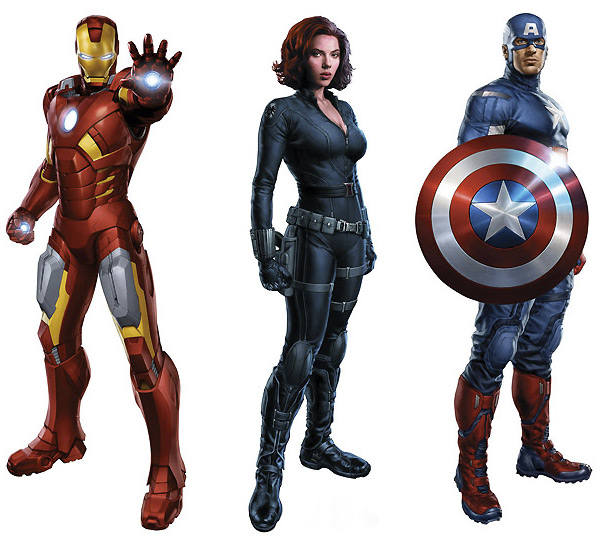
The reviewer for "World Net Daily" pointed out that the movie seemed to be in favor of one God. There is one scene where Natasha Romanoff (Black Widow) states, concerning Loki and Thor, "These guys come from legend, Captain. They're basically gods."

Steve Rogers (Captain America) responds,"There's only one God, Ma'am," and then, comically,"And I'm pretty sure he doesn't dress like that."

There's another scene where Loki demands "worship" from the Hulk. Loki orates, "You are, all of you are beneath me! I am a god, you dull creature,and I shall not be bullied..." Then there is a brief gratifying scene where the Hulk picks up Loki like a rag doll and and whips him around, smashing him into the ground. It's strange to say that I would enjoy this violence, but after such a comment, the audience enjoys seeing the villain put in his proper place. After this, Hulk tells him, "Puny god."

My friend and I were sufficiently creeped out by Loki, which is, of course, how we were supposed to feel, as he is the villain. We were creeped out by his appearance and manner. At one point during the movie, my friend turned to whisper to me and said, "He's like a demon."

I thought there was something to that. Satan, who started out as an angel of God, was thrown from heaven for the sin of pride. Even today,he would like to think of himself as equal to God or a god and demand our worship. So, for me, there was another sense in which he was "like a demon" besides his creepiness.

There is another "worship" type scene in which I saw more of a political implication, which was, perhaps, the intention of the script writers. The scene is in Stuttgart, Germany, and Loki is in front of a crowd.

"Kneel before me," I said. "Kneel! Is this not simpler? Is this not your natural state? The bright lure of freedom diminishes your life's joys in a mad scramble for power. For identity. You were made to be ruled. In the end, you will always kneel."
An old German man stands and says, "Not to men like you."

"There are no men like me," says Loki.

The German man says, "There are always men like you." Of course, I don't think it was coincidental that Captain America is the hero that swoops down at the appropriate moment to save this man.

The Stuttgart setting, I think, is intended to bring Hitler to mind as well as the rest of the political dictators who may have a similar attitude as Loki. So, it was interesting that the hero was Captain America, which seemed to symbolize some American patriotism and the American idea of political freedom.

But there was another scene from which I drew a spiritual parallel. This is the scene where Loki is taunting Black Widow.

Loki asks her, "What is it that you want?"

"It's really not that complicated," she says. "I've got red in my ledger, and I want to wipe it out."

Loki taunts her,"Can you? Can you wipe out that much red?" And later,"Your ledger is dripping, it's gushing red, and you think saving a man no more virtuous than yourself will change that?"

That, again, seems demonic in the sense that Loki is trying to point out her own weakness and her own inability to save herself, to redeem herself by doing enough virtuous deeds to wipe out the evil ones. But this is where the spiritual parallel ends, at least, a theologically correct one.

It's a popular religious misconception that God weighs our good deeds versus our evil deeds to determine if we are worthy of heaven. But,I'm glad God is merciful, knows my weaknesses and knows I can't earn heaven by outweighing my evil deeds with good ones. In Romans 3:10, "As it is written, there is none righteous, no not one." And Romans 3:23 "For all have sinned and fall short of the glory of God."

The solution is much easier."For by grace are ye saved through faith; and that not of yourselves: it is the gift of God: Not of works, lest any man should boast" (Ephesians 2:8-9 KJV).