A little spot for my thoughts on books, music, art, movies and other random subjects as well as a place to highlight my own fiction.
Tuesday, July 3, 2012
"How To Tell a Prince from a Frog" -- Interview with Artist and Author Christine Kerrick
Christine Kerrick is a wonderful and talented artist. She is a friend I know only through facebook, but I've admired her art for a while.
I've enjoyed her whimsical art like this one.
And her art centered on spiritual themes...
When I found out she had a book coming out, "How To Tell a Prince From a Frog: Law Enforcement Techniques For Knowing Who You're Dating," I knew I could get behind her with it.
I told Christine that I joke sometimes that I should write a book called "Dates From Hell and How To Avoid Them."
I know some princes. Three of them are my biological brothers. Some of them are my Christian brothers, and some have already found their princesses. I'm grateful for the good guys in my life.
But, I've also known some frogs. I seem to attract them. The froggiest of frogs and the wartiest of toads have hopped out of the bog to either date me or be my admirer. I've known a frog with a prison record, a frog who ended up in prison some time after I was no longer in contact with him, a frog with a drug abuse history, a frog with mental illness, who was also a liar and manipulator, and frogs who showed warning signs that they had the capacity to be abusive (although I was not the victim of it) either sexually or physically. My experiences were short-lived, because I did see the warning signs. I did not pick up these men (ahem, frogs) in bars. I met them in what should be the safest of all places to meet a potential mate, in church.
I apologize to any reader who may be avoiding church with the thought that the church is full of hypocrites, because the above statement would seem to confirm your fear. The father of Corrie Ten Boom, a Christian Dutch woman who hid Jews in her home during the Holocaust, once said, "Just because a mouse gets into the cookie jar doesn't make him a cookie." Just like that mouse in the cookie jar, going to church by itself doesn't necessarily make a person a Christian. Even Jesus Himself talked about hypocrites whom He likened to "whitened sepulchres" and false prophets whom He called wolves in sheep's clothing. Notice that if there are wolves in sheep's clothing among the flock, there is also a true flock.
In Matthew 10:16, Jesus says to His disciples, "Behold, I send you forth as sheep in the midst of wolves: be ye therefore wise as serpents, and harmless as doves." In other words, we should be harmless but not naive. Christine's book should equip you to be "wise as a serpent."
Her book addresses how to pick up on clues of your date's character, whether good or bad, and how to recognize red flags.
Christine Kerrick was born and raised in West Chester, Pennsylvania and received a BFA in illustration from the University of the Arts in Philadelphia. Christine has some other book projects in the works as well as six published comic books which, of course, she illustrated herself.
One of Christine Kerrick's comic books below:
"How To Tell a Prince From a Frog" also features several of Christine's illustrations.
"I love writing fiction and have written six comic books. I am working on a couple of novels and have finished (but not published) a children's book. I'm working on a second one," she said.
Christine told me she felt inspired to write her current book "when I met one final Frog who lied to me and manipulated me and those around me."
Christine's artwork below, "Sweet Nothings," is intended to represent a sweet-talking liar.
"I wondered how this could happen and how I could let someone so dangerous slip past me. As I started researching things, I saw that other women had encountered dangerous men like this one too," she said.
The book is aimed towards single women of any age, not necessarily towards teenagers or young women.
Christine feels that her personal experiences have given her the wisdom to write this book.
"I couldn't have written this before that final experience with deception. I have also done extensive research in the years following and talked to scores of women about their experiences, all of whom share many common threads as far as how these Frogs deceived, what they said, the repetitive nature of their sins and the fact that the women 'knew' something was off but went ahead anyway," said Christine.
I noted that the title of the book sounds humorous and asked if the book's content was humorous.
"It is humorous off and on, but focuses on teaching and encouragement," said Christine. "It is a heavy subject, so I tried to inject humor whenever I could."
Christine expressed that frogs can be found in other contexts besides dating such as in business or acquaintance type relationships.
"This isn't to say we should condemn people but be able to know the signs that they are being deceptive and be wise enough to either confront the topic with them or leave and move on. In a dating realm, it is better to move on when you experience deception. Someone who lies to you or otherwise deceives you is not someone who will make a trustworthy spouse," she stated.
Purchase Christine's new book on Amazon and learn to distinguish a prince from a frog!
Saturday, June 30, 2012
Robot "Love?"
In 2004, I went to the theater with a friend to see the movie "Stepford Wives." Even before I had seen the movie, I had some understanding of the basic story concept since my mother had seen the 1975 version of the movie.
The story, a slightly creepy dark comedy, explores several interesting ideas. What if a human being could be robotically programmed to "love" you? Would that love be rewarding if the person's will was not involved? Similar themes have been explored in other ways such as in the movie "Love Potion Number 9." What if someone loved you but only because that person was under the influence of a potion?
Sandra Bullock and Tate Donovan in "Love Potion Number 9."
"Stepford Wives" also explores another "what if." What if a human being could be robotically programmed to do all the perfect things? The person's natural weaknesses and flaws would be erased. The person would be "perfect," but the person's will is not involved. How rewarding could this arrangement be?
The Female Improvement System
Although the 2004 "Stepford Wives" movie explores the husband and wife relationship, with the wife as robot, the '70's series of movies included "Stepford Children" and "Stepford Husbands," so the same concept could be applied to artificially perfect husbands and children. If your wife or husband, son or daughter hugged you, but only because they were programmed to do so, would it be as rewarding as if it were an act of the will? Planting computer chips in human brains is a bit far-fetched for real life, but other mind control devices such as brainwashing and hypnosis are not.
Sometimes experts in hypnosis persuade people to do goofy things they wouldn't normally do for our entertainment. I personally would never volunteer for such an experiment, but at the same time, I confess I have found watching these experiments entertaining and disturbing at the same time. Below is a man hypnotising members of an audience at a state fair. Notice that one of the girls is convinced she is in love with the hypnotist and wants to hug him.
On the subject of robotics, I've been doing a bit of reading as research for some of my fiction writing. Some roboticists are interested in making robots as human-like as possible. This Japanese humanoid robot below, HRP-4C, sings and dances while imitating human-like mouth and head movements and human breathing.
The "Daily Mail" online, on June 12 of this year, had an article about this "last moment" robot below that could soothe a lonely person who is about to die in lieu of family or friends.
Eddie Wrenn of the "Daily Mail" writes:
"A smooth white robot starts gently rubbing your arm with a swing-saw motion and then, with a metallic voice, says: 'I am the Last Moment Robot. I am here to help you and guide you through your last moment on Earth. 'I am sorry that your family and friends can't be with you right now, but don't be afraid. I am here to comfort you. You are not alone, you are with me. Your family and friends love you very much, they will remember you after you are gone. ' Last moments: The robot gently swings its arm back and forth to simulate a relaxing stroke.
Is this a better way to go than dying alone? Or is it creepy? Is this kind of affection wanted when it is received by placebo, or worse, simply the pre-recorded responses from an unthinking, programmed machine?"
As fascinating as robot technology is, I don't think robots can replace humans in such a personal role, and judging from the reaction to the article, I think most people agree.
On a less creepy note, Connie Francis, in the '60's, sang a light and funny song, but suitable to the theme of this blog, "Robot Man," about how a robot's company would be more reliable than a live date. Here are some actual robots dancing to the song.
Really though, the "Stepford Wives" story plot has always made me think of a theological application. God could have created us, automatically programmed to be morally perfect and to love God as He loves us. He didn't He gave us free will.
"For God so loved the world that He gave His only begotten Son that whosoever believes in Him should not perish but have everlasting life." John 3:16 To believe or not to believe is a choice of our will.
Once we believe, God works with us to morally perfect us. Romans 8:28 a"And we know that for those who love God all things work together for good, for those who are called according to his purpose. For those whom he foreknew he also predestined to be conformed to the image of his Son..."
From C.S. Lewis in "Mere Christianity:"
"God created things which had free will. That means creatures which cn either go wrong or right. Some people think they can imagine a creature which was free but had no possibility of going wrong: I can not. If a thing is free to be good, it is also free to be bad. It makes evil possible. Why then did God give us free will? Because free will, though it makes evil possible, is also the only thing that makes possible any love or goodness or joy worth having. A world of automata -- of creatures that worked like machines -- would hardly be worth creating. The happiness which God designs for His higher creatures is the happiness of being freely, voluntarily united to Him and to each other in an ecstasy of love and delight compared with which the most rapturous love between a man and a woman on this earth is mere milk and water. And for that they must be free."
Saturday, June 23, 2012
"Brave," Movies and Romance
During the archery scene, there is a lot of silliness with the various suitors showing off, flexing muscles and sometimes acting more clumsy than skilled. Fathers brag on their sons and their supposed macho and military feats. Of course, Merida is not impressed by their braggadocio or bravado.
Strangely enough, this made me think of modern dating in our modern culture. Watching this movie, we somehow sense that this scene, and this method of selecting a mate, is silly. But some modern people's concepts are equally silly, and sometimes, it is mature singles (at least in terms of age) who have silly junior high concepts that we can select a mate just by scanning a sea of faces and picking out the prettiest one.
Why is this? Modern people should have grown up hearing that it's wrong to be shallow and expressions like "Beauty is only skin deep," right? But we've also grown up with movies that glorify the idea of infatuation and promote it as true love, that promote the idea that love is something that will slap us silly some day, that we can't control and that we "fall into."
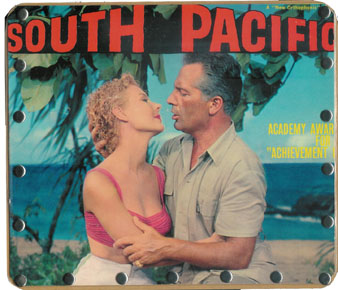
"Some enchanted evening, you will see a stranger across a crowded room, and somehow you'll know, you'll know even then, somehow you will see her again and again." from "South Pacific"
I admit I like the "South Pacific" movie for the beautiful music, but some of the romantic concepts are faulty. Even worse than the "across a crowded room" idea with Nellie and Emile is the scene with Lieutenant Joe Cable and the Polynesian Liat. These two do not speak the same language. On first meeting her, Cable says to Liat, "Avez-vous peur?" which is, "Are you afraid?" in French. The next moment, she has thrown herself on him, demonstrating just how unafraid of him she is, and they make out, and, it is implied...they go further. The greater theme in "South Pacific" is overcoming prejudices of various kinds, which I do appreciate. Many of the more recent romance movies are even worse in their depiction of infatuation and shallow relationships, showing people passionate about each other who just barely met.
Once, while on a dating site, I had a man chatting with me who wanted to meet me right away. I'm pleased to say that I did not agree to meet him. He kept carrying on about how I was "his type," judging from my photo. As surprised as I was that I could be anyone's physical type, I was not impressed by this flattery. I'd rather have someone look at my profile and take this approach, "Hey, I see you like (insert interest here.) So do I!" rather than "Gee, yer perty!" He was also convinced we were made for each other when he found out we both listened to one of the same radio stations, but this is also a bit of a silly conclusion, after talking to someone for only five minutes.
I perused match.com several years ago. I don't think I was ever an official member. I was astonished by one man's profile that included a two paragraph long description of his ideal mate. She had to be Italian and wear her hair a certain way and wear lots of lip gloss. His very long description was purely physical with no listing of personality, values or other inner qualifications. I thought to myself, "How can he expect that such a person, if he finds her, will 1) be attracted to him and 2) be a decent person who shares some compatibility?" This may not be kind, but I hoped he would find such a woman, and she would be his own punishment for having such a foolish idea. A person's looks alone tells you almost nothing of importance. It might tell you something about the person's neatness habits or fitness, but that's all.
I've been reading in "The World's Greatest Love Letters." In one of these historical letters, one man wrote to his wife, "Love is only friendship in a more exalted form." I wish I could recall who wrote that one! (I'll comment later if I can find it.) That, I think, is the best idea, romantic love that has a friendship basis. We can hope that Merida finds love in her own time in this manner. But, how can infatuation be "friendship in an exalted form?" Perhaps, in some cases, if infatuation settles down and matures, it could transform that way.
Monday, February 14, 2011
Real Love on Valentine's Day

This Valentine's Day, I thought I would share some quotes on love from one of my favorite writers, C. S. Lewis. "Love is not affectionate feeling, but a steady wish for the loved person's
ultimate good as far as it can be obtained."
C.S. Lewis in "God in the Dock"
"There is no safe investment. To love at all is to be vulnerable. Love anything, and your heart will certainly be broken. If you want to make sure of keeping it intact, you must give your heart to no one, not even an animal. Wrap it carefully round with hobbies and little luxuries; avoid all entanglements; lock it up safe in the casket or coffin of your selfishness. But in that casket -- safe, dark, motionless, airless -- it will change. It will not be broken; it will become unbreakable, impenetrable, irredeemable."
C.S. Lewis in "The Four Loves"
"There are two kinds of love: we love wise and kind and beautiful people because we need them, but we love (or try to love) stupid and disagreeable people because they need us. The second kind is the more divine because that is how God loves us: not because we are lovable but because He is love, not because He needs to receive but He delights to give."
"The Collected Letters of C.S. Lewis," Volume III