Showing posts with label opinion. Show all posts

Wednesday, July 11, 2012

Musical Theater, Many Art Forms Melted Into One


Above, Shirley Jones as Marian Paroo and Robert Preston as Professor Harold Hill in the 1962, The Music Man.

I'm a fan of the musical comedy. A musical comedy can always make me smile, relax and de-stress. I know songs from musicals and their lyrics to an embarrassing degree. I once saw a T-shirt on zazzle.com that said, "Yes, I know all the lyrics to every musical, so sue me, sue me, shoot bullets through me," which was funny to me, because I recognized the "sue me, sue me" part as lyrics from Guys and Dolls.

Frank Sinatra as Nathan Detroit singing Sue Me, Sue Me to Vivian Blaine as Miss Adelaide in Guys and Dolls, 1955.


I think I like the musical, because it combines so many art forms I like into one: singing, dancing and storytelling/acting. At various times, I have sung in choirs and concerts, acted in dramas and danced for my own benefit and exercise, but I have never performed in a musical. You can, however, see how it might suit me.

Visual art is also an important element of the musical that can't be underestimated, the art that goes into costume design and set design. Musical comedies are often an explosion of color, with colors that pop and vibrate against one another...

Scene from West Side Story, 1961.


Or unrealistically monochromatic as if a whole town decided to dress alike for no particular reason.

The Shipoopi song from the 1962 movie, The Music Man


Think Pink from the 1957 Funny Face


In the above scene, the explosion of pink does have some pertinence to the plot in that it deals with employees of a fashion magazine and a new fashion trend.

It is the careful arrangement of color and beauty that adds so much to the musical experience. This past March, I went to visit a good friend in Florida. She and I visited Walt Disney World with her mother who said at one point that a visit to Disney World could give you sensory overload. The musical experience can be like that too, with so much for your eyes and ears to take in.

I realize not everyone is a fan of the genre. I remember, back in college days, overhearing a guy in the cafeteria making fun of musicals and, specifically, West Side Story. With a cheesy, pasted-on smile, he snapped his fingers and made up his own lyrics for the fictional gang members, "We've got your drugs, and we're going to kill you." Looking back on it, I laugh. I can understand why he would see the ridiculousness of a bunch of tough guy gang members slinking down dark alleys and breaking out into spontaneous dance, especially as some of the dance moves in the movie are ballet-related. (Those moves are, however, masculine.) A more modern retelling of the story might have the Sharks and Jets dancing hiphop style. Not all musicals are comedies. Some, such as West Side Story and Les Miserables, can communicate drama, tragedy and serious ideas.

Dancing Jets in West Side Story


I think it is this spontaneous song and dance in the midst of the story that those who are not fans find hard to understand. A friend of mine once, speaking to me about it, complained that musicals were unrealistic. I then told him, "Well, comic books are similarly unrealistic," since he is a fan of comic books. He then acted as if I had stepped on his toes. It wasn't my intention to insult something he liked but only to point out that people enjoy many art forms that are not strictly realistic. The 2007 Disney movie Enchanted has a song and dance scene that mocks the very idea of a spontaneous song and dance breaking out of nowhere. And you know what? I actually love it.

That's How You Know from Disney's Enchanted


I think of these spontaneous songs as like unto a Shakespearean aside or monologue. It is not realistic for a person to make little speeches to himself either. It is merely a technique to make us privy to that character's feelings at the moment. Songs in musicals serve the same purpose. Instead of expressing feelings in a monologue or dialogue or some other action, the character expresses it through song and dance. So, if you don't get hung up on the lack of strict realism, you can enjoy the format.

Maria Von Trapp, in The Sound of Music, can work out her anxiety in I Have Confidence in Me, and Anna Leonowens, in The King and I, can do the same thing in Whenever I Am Afraid.

Deborah Kerr as Anna Leonowen and Yul Brynner as the King of Siam in the 1955 The King and I


I don't think I will get tired of the musical, of discovering new ones or discovering old classics.

Friday, June 29, 2012

"Chitty Chitty Bang Bang" and "Mars Needs Moms" -- What These Movies Say About Motherhood

Before I offend some female readers, I think I should preface this blog by saying that I am not opposed to all women's progress accomplished by the feminist movement. I'm glad American women have the right to vote, that we can pursue a number of interesting careers, and, especially personally, that we can write books under our own names rather than Currer Bell(Charlotte Bronte)and George Eliot(Mary Anne Evans.)I'm glad that the 19th century "Bloomers" thought it was a good idea women should have more practical clothing than skirts to our ankles for doing more active things such as riding a bicycle.


I might even agree with some of the issues supported by today's feminists such as in this partial statement from Wikipedia, "Since the 1980s, standpoint feminists have argued that the feminist movement should address global issues (such as rape, incest, and prostitution) and culturally specific issues (such as female genital mutilation in some parts of Africa and the Middle East..."

I do have a problem with ultra-feminism, where women want to be superior and not just equal to men, where motherhood and children (particularly unborn children) are devalued. That said, I will point out the anti-feminism themes I see in two movies.


I grew up listening to two Disney movie soundtracks on vinyl record. As the movies were released in the theater before I was born, I was familiar with the soundtracks long before I actually viewed the movies. One was "Mary Poppins." The other was "Chitty Chitty Bang Bang." I love both. The story of "Chitty Chitty Bang Bang," as presented in the Disney movie, has so many elements that I enjoy: the Victorian setting, the folk art aesthetic, a family friendly story and an absent-minded inventor/dreamer/visionary main character. It's hard for me to fully express just what I love about this movie.


In recent years, as an adult, I read the original "Chitty Chitty Bang Bang" book by Ian Fleming, who is more famous for his James Bond stories. I was disappointed that, aside from the main characters and their ridiculous names like Truly Scrumptious and Caractacus Potts (perhaps to imply Cracked Pot) and Chitty Chitty Bang Bang, the flying car, the book had absolutely no resemblance to the movie whatsoever. The plot is entirely different. There is no trip to Vulgaria, no Baron and Baroness Bomburst and no children banned to the underground. I have to confess I like the Disney movie plot better.

As an adult, however, I see something different in the movie than I saw as a youth. Children are outlawed in Vulgaria. The baroness who rules the land recoils from children as if they were mice or vermin.


This makes me think of China where there is a two child limit per household, and children are aborted to keep the number under this quota. But it also makes me think of the selfish ultra-feminist who devalues children as an inconvenience, who treats the unborn child as an extension of the mother's body, a lump of unfeeling flesh to be disposed of if it's inconvenient. She has the right to abort, because "It's my body" as if aborting a baby was something like trimming hair or nails. Clearly, there are two bodies involved.

A sixteen-week-old baby in utero


I have some past experience as a child care worker, and I saw an ugly side to motherhood there too, as did the writers of "The Nanny Diaries," a selfish motherhood that puts career above all else, where children are shuffled from one program to the next, to before-care, then school, then after-care to ballet or karate class. I cared for affection-starved children who wanted me to hug and cuddle them and asked me, "Pretend you're my mom."


The fact that the child-hating baroness is the villain, and the story is in favor of the children, seems to me to have a parallel to a pro-life and pro-children message, whether or not that was the intention of the Disney writers.

The other more recent movie where I saw a subtle anti-feminist message was in "Mars Needs Moms." Other reviewers saw just the opposite, but since this female-dominated world (on Mars) is presented in a negative not positive light, I see it as taking a different stance. Although perhaps it could be stated that children viewing the movie might not be able to see the subtlety.


In the female-dominated world of Mars, young girls are raised by nanny-bots, not mothers, and young boys are thrown into the trash heap where they are raised by the "hairy tribe guys." I have to think that the script writers are making a point about ultra-feminism and not a positive one.

In the end, they discover a cave painting that shows "two parents," showing that in the past Mars had a family structure more similar to that on Earth. They had forgotten about a mother's care and love for her children and the need for children to have two parents. One critical reviewer disliked the fact that the word "father" is never mentioned specifically in the movie. I can understand that, but perhaps the point was that this society had degraded to such a point they no longer understood what "father" was. However, the point of the movie seems to be that two parents is a good thing rather than otherwise.


The fact that the young boys are treated so differently than girls in the Mars society is, of course, disturbing. I remember (not verbatim) the disdainful line that the villainous matriarch of the society makes about young boys, "always laughing and playing." There does seem to be a similar prejudice in our modern society about active and excitable young boys.

I was talking some months ago to a female friend of mine who is the mother of two teenaged boys. She mentioned a female educator who unfairly made things difficult for her sons on a number of occasions and had the nerve to announce during a public ceremony that she "hated boys." Really? It reminded me of stories my own mother has told me about when my oldest brother was in elementary school. My poor brother who was a quiet, well-behaved boy who was far from being hyper was getting stomach aches from the stress his teacher put on him and the boys in his class in general. She screamed and yelled in a paranoid way even when they were behaved, and one time, my mother caught her in the act and understood my brother's stress.

Why are so many children, especially boys, labelled ADD and ADHD? It may not be natural to every boy (or girl,)especially at a young age, to sit quietly in school for hours on end. I tend to think, and this is just my opinion, that these levels of energy are more basic and normal human differences. Why is the active child "abnormal" and needs a label and a prescription for Ritalin? If these children are so abnormal, why are there so many of them? There may be some cases where medication is needed, where the problem has some root in some neurological abnormality, but I don't believe it's a good thing to label a child because he exhibits some unwanted traits or to give out Ritalin as a panacea.


The throwaway children in both movies, the underground children in "Chitty Chitty Bang Bang" and the trash heap boys in "Mars Needs Moms", makes me think of another social problem that is not a direct result of feminism, street children in Peru. The problem comes as a result of the breakdown of the family, as much from problematic fathers as problematic mothers, but the boys in the trash heap of Mars make me think of the boys in the trash heaps of Peru. My pastor has written a book, Habitations of Cruelty, about this very problem and other problems affecting the world's children. There are, I believe a preponderance of street children in other nations as well, but my church in particular has concerned itself with the street boys of Peru, supporting an organization called Centro Shama.


From the Centro Shama website,
"Only in Lima it is calculated that approximately 1500 to 2000 boys, girls and adolescents, with the age among 6 to 17 years, are living in the street. This phenomenon is consequence of the family crisis that we experience, the increment of disfunctioning families, extreme poverty, migration to Lima, that during the last two decades ascended to exorbitant percentages, the crisis of values that our society experience and the infantile abuse, that every day is increasing. All this causes, that every day a boy escapes from his house."


I'm so happy that my church supports the shelter, care and rehabilitation of these children at Centro Shama.


Thursday, June 28, 2012

Women's Beauty, Photoshop and the Pursuit of an Ideal


Here is Keira Knightly in a poster for the movie "King Arthur" before and after Photoshopping. In the Photoshopped poster, her waist shrunk and her bust grew. According to an article by Dana Macario on MSNBC News online, "Concerned that the perfect images of celebrities we see every day are affecting kids' self-esteem, the Brits are fighting back. As part of a Body Confidence campaign, the government is urging parents to teach their kids about altered images." The British government is apparently providing youth with downloadable pamphlets showing images altered with Photoshop, concerned these ideal images would be damaging to self esteem and put girls under extraordinary pressure to measure up.

There are some videos I've seen put out by Dove, the soap company, that show similar transformations of models going through the entire process of beauty, make-up, photos and then all of the Photoshop retouching to the photos. They are astonishing to watch. This model, prior to this rigorous routine, actually seems to look much more like an every day "ordinary" woman.


I'm not suggesting women "let themselves go." I'm all in favor of women doing all they can within reasonable means to look their personal best which may include proper diet, exercise, makeup, choosing clothes that are flattering and so forth. Clearly though, some women, and young teen girls especially, go through turmoil in their pursuit of perfection and develop self-harmful behaviors like anorexia and bulimia. I also believe that plastic surgery, except for cases such as in correcting a birth defect or damage from an accident, is also going to harmful extremes in the pursuit of beauty.

Women have been distorting and crippling their bodies throughout history in the pursuit of a beauty considered ideal by the culture of the time. There was the practice of foot binding that took place in China up until the early 20th century. It stunted foot growth and caused women to hobble. I apologize for this painful photo below.


Some would say today's high heeled shoes and pointy toed shoes for women are also potentially damaging to the feet.

From Stylite.com on January 25 of this year, "In results published last week in 'The Journal of Applied Physiology,' the scientists found that heel wearers moved with shorter, more forceful strides than the control group, their feet perpetually in a flexed, toes-pointed position. This movement pattern continued even when the women kicked off their heels and walked barefoot. As a result, the fibers in their calf muscles had shortened and they put much greater mechanical strain on their calf muscles than the control group did." This information, by the way, has not prevented me from wearing heels, but neither do I wear them every day and for every occasion.


In Victorian times, bustles and corsets were used to enhance and create an unnatural silhouette. Look at this "Gibson girl" with her corseted waist. Does this not look painful? No wonder the women in Victorian novels are prone to fainting.


Much of what we see in Hollywood today is "fake" or artificially enhanced beauty, as so many celebrity women, the ones that are considered "bombshells," received their unnatural proportions through surgical enhancement. As harmful as this is to young girls, I think it may also be just as harmful to men. Even men who choose to avoid pornography -- it's easy enough to stumble across it accidentally on the Internet -- could be more subtly influenced by the media in unrealistic expectations of female beauty.

Wednesday, June 27, 2012

Assorted Thoughts on Reading Inspired by C.S. Lewis

C.S. Lewis is a personal hero of mine for his imaginative writing and his theological writing, spiritual insights, deep thinking, studious nature and many other reasons. He was also a voracious reader all his life, starting in childhood.


"You could never get a cup of tea large enough or a book large enough to suit me."

I can relate to this, can you? I am continuously reading. I constantly desire to enrich my mind and learn and explore new things or just appreciate the beauty of language and storytelling. Now that I have a Kindle, I can carry a large library with me everywhere. Some evenings, I go from my office to restaurants for dinner and then to municipal meetings at night.(I'm a reporter.)So, my Kindle is my companion when I eat solo or when I have a waiting period before the meeting starts or when the municipal council goes into a closed session. Council people will approach me and ask in a friendly way, "What are you reading today?"

I've heard many people say they prefer traditional books made from paper to the Kindle or the Nook, and I can understand those feelings somewhat. I would never want these contraptions to completely replace traditional books. However, it is much easier to carry around a "large book" such as Lewis liked around on a Kindle than tote around, say, "War and Peace" to read on your lunch break (which I actually did at a former job.)Toting "War and Peace" might be just as much exercise for the body as for the mind.

I only half-agree with Lewis on the tea part though. I'm an American but have a bit of the Anglophile about me. I adore pretty tea cups and teapots, and I do drink tea fairly often. My favorites are Darjeeling and Earl Grey. This said, I prefer coffee. So, this mug with a similar quote is perhaps more personally suitable.


I remember how inspired I was after reading Lewis's autobiography, "Surprised by Joy," reading just how voraciously Lewis read growing up. I remember reading how his family never borrowed books from libraries but always bought them and how they did not put any limitations on what books he could read. He did some pretty ambitious reading at a young age. Books were stashed in odd places throughout the house, even stacked on the stairs. This photograph I found on Pinterest reminded me of it.


I don't recommend this book storage system. I don't have a husband, but I think this would drive a husband berserk. As a single, I would still want friends and guests, and this, I would imagine, would drive your friends and guests berserk too. As much as I love books, I love people more. Still, it makes quite an interesting visual.

I've made such a hero of Lewis that, when I read about the books that inspired him, I have a desire to read those same writers and books. So, in recent years, I have explored George MacDonald and G.K.Chesterton like the books listed below.


I also have an interest in reading books written by the other Inklings, Lewis's writing friends, such as Tolkien.


I don't read these writers exclusively, but Lewis's example to me has inspired me to read more, to read more books of great quality and to keep book lists of the works I read each year.

This brings me to another quote of his.


One of my goals is to read more.

1) Read more good books.

2)Write good books. Finish what you start. Publish to Kindle.

3)Exercise more.

4)Lose weight.

5)Work on my weaknesses. Develop, with God's help, those positive traits that don't come naturally to my personality type. I am, by the way, a phlegmatic.

What are your goals?

Tuesday, June 26, 2012

Primitive Art and Child Art -- Miro vs. Olmstead


A friend of mine recently talked to me about surrealist artist Joan Miro and said, "It looked like something a five-year-old would draw." Looking at this one, the painting "Sonnens" above, I tend to agree with my friend. It certainly looks like something a five-year-old would do. Actually, come to think of it, it reminds me somewhat of Wall-E from the Pixar movie, only Wall-E was much more skillfully rendered. It hardly took the skill to make this painting as it did for Michelangelo to paint the ceiling of the Sistine Chapel or sculpt the "David," so it does make you wonder how this is just as museum worthy as Michelangelo.

Anyone else see a resemblance?


According to Wikipedia,"Earning international acclaim, his work has been interpreted as Surrealism, a sandbox for the subconscious mind, a re-creation of the childlike, and a manifestation of Catalan pride. In numerous interviews dating from the 1930s onwards, Miró expressed contempt for conventional painting methods as a way of supporting bourgeois society, and famously declared an 'assassination of painting' in favor of upsetting the visual elements of established painting." So, "childlike" is actually mentioned in one of the opening paragraphs of the article. Obviously, my friend and I are not the only ones who've made such an observation.

Just like not all Picasso's paintings were cubist and some had more realism, for example, "The Old Man with Guitar," so Miro does have a few paintings that show a little bit more realism. I can't say the painting below, "Painting of Toledo" looks like something a five-year-old would do. It is a bit of a surrealist landscape with the unnatural colors and wavy lines in the foreground, and even the more realistic building is only semi-realistic, but I don't mind it quite so much. As a whole, it makes me think of some of the Post-Impressionists like Van Gogh or Cezanne. I can see it as a stylistic sort of illustration for, say, a fantasy story of some sort. When my focus is on the foreground, I'm reminded more of psychedelic art.


Many of Miro's paintings I've observed are more similar to the one below, "The Red Sun," an abstract and odd assortment of peculiar shapes with a lot of use of primary colors. His paintings may show a sense of balance and a use of vibrating color, but there is not an incredible amount of skill involved that is different or superior than what a lot of other artists could easily do. According to www.joanmiro.com, "Joan Miro had a very eccentric style that is the embodiment of his unique approach to his artwork." I suppose that's what is unique about him, that he defined his own style, one that may be as difficult to imitate convincingly as some individual's quirky handwriting. I wonder if anyone has tried to forge an "undiscovered" Miro? His quirky style is, however, not something I prefer. Much of the modern art in museums seem more like philosophical statements, in his case maybe the "assassination of art," than works of superior skill.


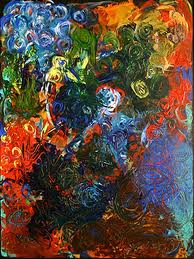
Recently, I have read about a six-year-old abstract artist, Maria Olmstead, who is selling her paintings for big bucks. When it comes to Miro vs. Olmstead, I prefer the actual child paintings to the childlike Miro paintings.

This is not something the average six-year-old paints. For instance,I remember a painting my nephew Bill created as a child where colors were swirled together and turned into a muddy puddle. No offense to Bill. His skills lie elsewhere, in math and in computer programming. :) Olmstead's painting style may not be realistic, and it may be somewhat random, but it is also a very pleasing pattern of texture and color. There is, I think, a place for that in the world of art and design. Below is her painting "Lollipop House."


I do realize that artistic preferences are somewhat subjective. "Lollipop House" is not likely a painting I would love to have framed on my wall, because my preference for wall art is more representational than abstract. It is something that I feel would be a great design for any number of textiles or fabrics, rugs, scarves, etc., where the design is repeated over a large surface. What is your preference, child artist Olmstead or childlike artist Miro?